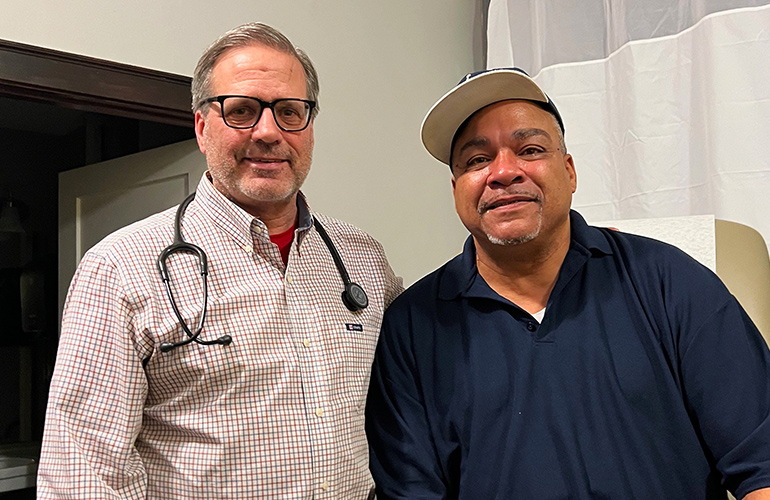
Last summer, Eddie Khamis was scheduled for rotator cuff surgery on his left shoulder and carpal tunnel surgery for an injury to his right hand. But when his surgeon learned he didn’t have a place to recover the hospital canceled.
Khamis, 64, was evicted from his apartment in Elk Grove Village last year after his pension could no longer cover his increased rent. He found himself living in a Salvation Army shelter when he reached out to Connections for the Homeless for help.
The nonprofit provides a full range of health and wellness services to address the medical and behavioral health needs of individuals experiencing homelessness, including medical respite care with short-term housing to help keep people off the street as they recover from acute illness or conditions and seek long-term housing solutions.
With the help of a grant from Blue Cross and Blue Shield of Illinois, Connections for the Homeless provided care to more than 400 individuals in 2025 through its health and wellness services program, which includes the medical respite program launched last year. The investment is part of BCBSIL’s Blue Impact℠ grant program, which supports organizations addressing social and economic factors that affect health.
Khamis worked with the organization’s physician and medical director, Dr. Keith Boyd, to enter the respite program in December. Khamis is now fully recovered from his carpal tunnel surgery and recovering from rotator cuff surgery.
“When I was on the street it was like living in hell,” says Khamis, a Blue Cross and Blue Shield of Illinois Medicaid member. “I’m glad I’m here now.”
Healthy communities
For nearly 40 years, Connections for the Homeless has helped Evanston and northern Cook County’s most vulnerable residents by offering everything from assistance securing and retaining benefits and housing to emergency shelter and wraparound support services.
The organization provides basic needs through two drop-in centers located in Evanston. Their hotel-based Margarita Inn shelter has 42 rooms housing up to 65 people at a time, including children. The shelter is open 24/7 and provides meals, financial literacy classes, substance use support, housing case management, physician and behavioral health care and more.
Last year about 120 individuals lived at the temporary shelter, and more than 80% left with a permanent housing solution.
“Medical respite programs are surprisingly rare,” says Katie Cangemi, BCBSIL senior manager, community health initiatives. “Connections for the Homeless understands how important a safe and therapeutic environment is after being discharged from the hospital. Providing a safe and compassionate place to live is essential to healing and well-being.”
In addition to having a physician assistant, care coordinator, and two behavioral health specialists on staff, the nonprofit employs a practicing physician in Boyd. He and the team split time between the organization’s clinics and drop-in center and the Margarita Inn.